

Selling land that is subject to white land fees in Saudi Arabia no longer depends on the agreement between seller and buyer alone. The two sides may agree on the price and the date, and the deal can then stall at one step: documenting the transfer of ownership, known in practice as conveyance (ifrāgh). After Council of Ministers Resolution No. 263 dated 12/3/1448H, the practical question is: when can the transfer be documented, and what must be proven before you pay a deposit or hand over the price?
This article deals with that point specifically: the difference between the sale contract and documenting the transfer of ownership, the cases the Ministry of Municipalities and Housing has regulated, who bears the fee, and a checklist before signing. At each point we separate what the official sources state from what we regard as interpretation or possible application, which needs a legal review of the particular case.
Table of Contents
Short Answer: Is a Sale Blocked Before White Land Fees Are Paid?
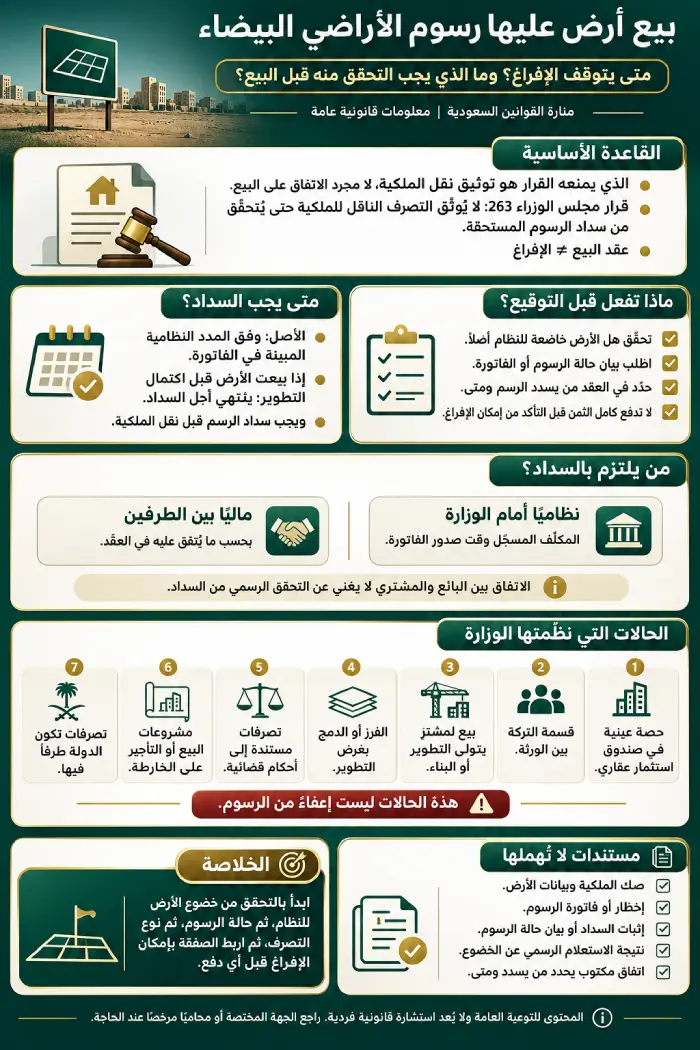
What the text of the resolution blocks is the documentation of the transfer of ownership. Resolution No. 263 provides that no real-estate disposition transferring ownership of land subject to the White Land Fees Law is to be documented until payment of the white land fees due on that land has been verified (text of the resolution in Umm Al-Qura (Arabic)). The agreement to sell, the sale contract and its validity are not addressed by the published text.
In practice: you can negotiate and perhaps draft a conditional agreement, but do not assume that the conveyance will go through before payment is verified. As for dispositions that do not transfer ownership, such as a mortgage, the resolution allows them to be documented in a way that protects the State’s right to the white land fees. On 4 November 2026 the Ministry of Municipalities and Housing announced seven cases of disposition subject to specified controls, and said that they do not represent an exemption from the fees (the Ministry’s announcement (Arabic)).
Two points remain for which we found no text in the official sources we read: the date from which the resolution applies to earlier deals, and how the financial burden of the fee is divided between seller and buyer. The statutory obligation to pay the Ministry is set by the Regulations, and we explain it in the section “Who Is Liable for White Land Fees, and Who Bears the Financial Burden?”.
What Changed in 2025 and 2026?
The relevant rules sit on four levels: the Law and its amendment, its Implementing Regulations, the Council of Ministers resolution, and the Ministry’s controls. Mixing them up produces outdated or exaggerated information, for example confusing the rate in Article 3 of the Law with the tiers in the Regulations.
| Date | Source and link | Most relevant to a sale |
|---|---|---|
| 12/2/1437H | White Land Fees Law (Royal Decree No. M/4) | The original Law. Its Article 3, as shown on the Ministry’s page, provides for an annual fee of 2.5% of the land’s value. |
| 7/11/1446H | Royal Decree No. M/244 amending the Law the Law as amended, in the Ministry’s text (Arabic) | Amended the Law and added vacant properties to its scope, and amended articles including 5, 6, 7 and 8 (the owner’s responsibility, the penalty, the committee and the objection). We did not read the text of the decree itself or its effective date; we reported what the Ministry’s page shows. |
| 19/2/1447H (published 22 August 2025) | Minister of Municipalities and Housing Decision No. 4700121073/1 adopting the Implementing Regulations decision text (Arabic) · Regulations text (Arabic) | The decision provides that it takes effect from its publication date, so the Regulations have been in force since 22 August 2025. They include the conditions for being subject to the fee, the fee tiers, the payment period, and Article 13(5) on selling before development is complete. |
| 24 August 2025 | Ministry announcement on the Regulations news item (English) | The Ministry said that annual fees reach up to 10% of the land’s value in the tier with the highest priority for urban development. |
| 8 June 2026 | Ministry of Municipalities and Housing page the page (English) | Objection within 60 days of notification, a committee decision within 60 days, payment within one Gregorian year, and the first invoices in certain zones of Riyadh from 1 January 2026. |
| 12/3/1448H (published 4 September 2026) | Council of Ministers Resolution No. 263 | No disposition that transfers ownership is documented before payment of the white land fees due is verified, while dispositions that do not transfer ownership may be documented in a way that protects the State’s right. |
| 4 November 2026 | Ministry of Municipalities and Housing announcement | Approval of controls on real-estate dispositions of land subject to the white land fees, and seven regulated cases, which are not an exemption from the fees. |
Note on effective dates: According to the text of the adopting decision, the Regulations are in force from the date that decision was published, i.e. 22 August 2025. As for Resolution No. 263, its published page gives no effective date and no transitional provisions; the page we read for the Ministry’s announcement does not publish the date from which the controls apply or the channel for the procedures; and we did not read the text of Decree M/244 or its effective date. For that reason we do not state a date that has not been established.
Is Your Land Subject to White Land Fees at All?
The Law does not apply to every plot. Article 7 of the Implementing Regulations sets the conditions: the land must be developable white land, located within a zone the Ministry has announced for the city; the total of such land that the person owns in the city must be at least 5,000 square metres; and its use must be permitted. A city comes within the scope of application through a ministerial announcement (Article 5).
As for the rate, you should not assume a single rate for all land. The sequence of the texts is as follows. Article 3 of the original Law (M/4) provided for an annual fee of 2.5% of the land’s value, which is what the Ministry’s version that we read shows, with no amendment mark on that article.
Royal Decree M/244 then amended the Law; the text of Article 3 after the amendment is on the Law’s page at the Bureau of Experts at the Council of Ministers (Arabic), a page we could not open while preparing this article, so we do not assert that the amendment raised the ceiling to 10%.
The Implementing Regulations adopted on 22 August 2025 then set tiers according to development priority: 10%, 7.5%, 5% and 2.5%, in addition to a tier outside the priority scope that carries no annual fee but is counted in the owner’s total holdings in the city (Article 6(2)); the Minister determines by decision the geographic zones within each city (Article 6(1)). On 24 August 2025 the Ministry announced that annual fees reach up to 10% of the land’s value in the highest-priority tier.
What is established from the texts we read is that the adopted Regulations and the Ministry’s announcement mention fees of up to 10% in the highest-priority tier. What we could not establish is how that figure ties to the text of Article 3 as amended. So take the rate and tier that apply to your land from your invoice or from the result of the official inquiry, not from a figure that is circulating online.
It is also worth noting that this is a fee, not a tax: that is the description in the title of the Law, even though the search phrase “white land tax” is common.
Sale Contract vs. Documenting the Ownership Transfer: How Do White Land Fees Affect Each?
A sale contract is an agreement between two parties on the price and their obligations. Documenting the transfer of ownership, known in practice as conveyance (ifrāgh), is the procedure by which ownership passes officially before the documenting authority. As we explain in our guide to a property sale contract without a title deed, a private sale paper may evidence the agreement, but it does not by itself replace transferring and registering ownership. That distinction is the key to understanding Resolution No. 263: the text concerns documenting the transfer, and does not address the making of the contract.
| Type of disposition | What it means | Effect of the white land fees according to the sources | What the text does not establish |
|---|---|---|---|
| Sale contract (the agreement) | The parties’ obligations on price, delivery and documentation. | Resolution No. 263 does not address preventing or invalidating the contract. | The effect of non-payment on the contract itself (rescission, compensation, a condition precedent) depends on its wording and facts. |
| Documenting the transfer of ownership (conveyance) | Passing ownership officially to the buyer. | Not documented until payment of the white land fees due is verified (Resolution No. 263, first). On a sale before development is complete, payment is required before ownership is transferred (Article 13(5)). | The mechanism for verifying payment and the authority that issues the proof. |
| Dispositions that do not transfer ownership (such as a mortgage) | A disposition over the land without transferring its ownership. | May be documented in a way that protects the State’s right to the fees without harming development (Resolution No. 263, second). | The detailed controls to be set by the ministerial committee. |
| The seven regulated cases | Paths for specific dispositions announced by the Ministry. | Special controls, not an exemption from the white land fees (announcement of 4 November 2026). | The detailed conditions of each case, unless the Ministry publishes them. |
When Does Documentation of an Ownership Transfer Stop? A Decision Flow
The flow below summarises the sequence of questions you should answer before signing. We start with whether the Law applies, then the fee status, then the type of disposition, then the regulated cases.
Note that the flow does not give a final answer at the second and fourth steps. Proving the fee status and applying the Ministry’s controls to a specific case are matters for the competent authority, and that is what you should ask for in writing before paying.
The Seven Cases Regulated by the Ministry of Municipalities and Housing
On 4 November 2026 the Ministry announced the approval of controls on real-estate dispositions of land subject to the fees, in implementation of Resolution No. 263, and specified the following cases as they appeared in its announcement. The announcement described them as regulatory paths that allow certain dispositions to be documented in line with their legal requirements, and stressed that they are not an exemption from the white land fees, that documenting them requires completing the necessary legal procedures, and that the obligation to pay the white land fees due continues under the specified controls.
| # | Case as stated | Note |
|---|---|---|
| 1 | Contributing the whole land as an in-kind share in the capital of a real estate investment fund. | The detailed conditions did not appear on the page we read. |
| 2 | Division of an estate among the heirs. | Dividing an inheritance is a separate subject that this article does not cover. |
| 3 | Selling the land to a buyer who undertakes its development or construction within the additional period granted to the liable person, under the specified conditions. | The specified conditions were not published on the page we read. How this case relates to Article 13(5) is explained in the next section. |
| 4 | Subdivision or consolidation of plots among the owners of land subject to the fees for the purpose of developing it. | The detailed conditions did not appear on the page we read. |
| 5 | Dispositions that transfer ownership on the basis of court judgments. | The payment mechanism in this case did not appear in the official source we read. |
| 6 | Dispositions carried out within approved off-plan sale and rental projects. | The detailed conditions did not appear on the page we read. |
| 7 | Dispositions to which the State is a party, and transfers of ownership due to expropriation for the public interest or temporary seizure of real estate. | Expropriation is a separate subject that this article does not cover. |
Some websites circulate precise conditions for each case, such as time periods or deposit mechanisms, which we did not find in the official source we read, so we did not adopt them. If your case is one of these, ask the competent authority for the full text of the controls before relying on any summary.
The Third Case and Article 13(5): What Is Established and What Is Not Settled
What the texts establish:
- Article 13(5) of the Regulations: when the liable person wants to sell the land before its development is complete, the payment period ends, and the person must pay the white land fees before ownership is transferred.
- Article 13(3): if an additional period for development or construction is granted, the payment period extends to its end.
- The third case as the Ministry announced it: a sale to a buyer who undertakes development or construction within the additional period granted to the liable person, under the specified conditions.
- The same announcement: the seven cases are not an exemption from the white land fees, and the obligation to pay continues under the controls.
What is not settled:
- Whether the controls of the third case modify the payment date set by Article 13(5), for example by deferring it until after the transfer or tying it to development, or keep payment before the transfer of ownership. We found nothing in the published sources that answers this.
- The specified conditions of this case and its procedures.
For that reason we do not treat the third case as an exception to Article 13(5), we do not say that it permits transfer before payment, and we do not say the opposite. If your deal is of this type, ask the competent authority in writing to state the procedure that will apply to it, and make the payment obligations in the contract consistent with it before paying the price.
When Must White Land Fees Be Paid on a Sale?
Article 13 of the Regulations governs the payment dates. The points most relevant to a sale are:
- The liable person must pay the fee and any penalty arising from a violation of the provisions of the Law or the Regulations (Article 13(1)).
- The fee is paid within one Gregorian year from the date the invoice is issued. Invoices for previous years are paid within 90 days of notification (Article 13(2)).
- If an additional period for development is granted, the payment period extends to its end (Article 13(3)); and if development is completed within the period after payment, the amounts paid for those periods are refunded (Article 13(4)).
- If the owner wants to sell the land before its development is complete, the payment period ends and the fee must be paid before ownership is transferred (Article 13(5)).
- The fee is suspended if there is an obstacle preventing the owner from dealing with the land during the payment period which the owner did not cause, and also if development is completed within the period (Article 8(1)).
The practical conclusion: selling before development is complete moves the payment date to before the transfer of ownership, so you cannot wait for the year to run out.
Who Is Liable for White Land Fees, and Who Bears the Financial Burden?
Two questions must be kept apart: who is legally obliged to pay the Ministry, and who actually bears the financial burden as between seller and buyer.
The Statutory Obligation to Pay the Ministry
Article 13(1) of the Regulations provides that the liable person must pay the fee and any penalty arising from a violation of the provisions of the Law or the Regulations. Article 1 defines the liable person as the natural or legal person whose name is registered in the land’s title document when the fee invoice is issued, and the definition includes anyone who succeeds that person under Sharia or the law. Article 5 of the Law, in its text as amended by Decree M/244, adds that the property owner is in all cases the first person responsible for paying the fees or penalties, unless they are paid by someone who stands in the owner’s position.
The Financial Burden Between Seller and Buyer
We found no text in the Regulations or in Resolution No. 263 that divides the fee between seller and buyer. Under the general rules of contract, the parties may agree that one of them bears the financial burden; that is an interpretation that needs a legal review of the particular case. Such an agreement is a contractual obligation between the two parties alone: we did not read any text that makes it a substitute for the statutory obligation to pay the Ministry, or for the official verification of payment before the ownership transfer is documented (Resolution No. 263 and Article 13(5)). If the contract is silent on who bears the fee, that becomes a potential source of dispute.
So state in the contract who pays, by when, what happens if payment is late, and that completion of the conveyance is conditional on proof of the official fee status, and keep the proof of payment issued by the official channel. If you are drafting a land sale contract, add fee clauses that reflect the status of the particular land, and have the drafting reviewed by a licensed lawyer.
Mortgages and Other Dispositions That Do Not Transfer Ownership
Paragraph “second” of Resolution No. 263 provides that dispositions that do not transfer ownership, including a mortgage, are documented in a way that protects the State’s right to the white land fees without affecting development, and that the ministerial committee sets the controls and procedures. The page we read did not publish those controls, so it would be wrong to state definite conditions for a mortgage, such as whether payment is or is not required before it is documented.
Inquiry, Payment and Objection: The Available Steps and What We Could Not Verify
Checking Whether Land Is Subject to the Fees
On its land-fee applicability service page (English), the Ministry describes a service that lets you check whether a particular plot is subject to white land fees using the title deed number or the real-estate registration number. The steps as stated on the service page are:
- Open the public portal of the White Lands and Vacant Properties Program (Arabic).
- Choose the city on the map.
- Enter the title deed number or the real-estate registration number.
- View the result on whether the land is subject, and the relevant category.
The page states that the service requires no login and no documents, that it is free and instant, and that it was last updated on 8 October 2026. We took these steps from the Ministry’s description, and read the English version of the service page because the Arabic version could not be opened; we did not run the service ourselves. If what you see on the platform differs from this description, the platform is the reference.
Invoices, Payment and Objection: What the Texts Establish
- Under Article 11 of the Regulations, the invoice includes the method of payment, the consequences of non-payment or delay, and the right to object. On the objection period, the article only refers to “statutory procedures”, so check the details stated on your own invoice.
- The Ministry’s page (8 June 2026) says that the liable person may object to the competent committee within 60 days of being notified of the invoice decision, and that the committee decides within 60 days of the objection.
- According to the text of the Law as amended on the Ministry’s page, the objection is submitted in writing to the committee referred to in Article 7 within sixty days of notification of the decision. It covers the decision to subject the property to the fee, the valuation of its value and the amount of the fee. The committee decides within sixty days of submission, and if it does not decide, the objection is deemed rejected. Committee decisions may be appealed before the competent administrative court (Articles 7 and 8).
We transcribed the Law’s articles from the page that presents it with its amendments, and could not compare them with the officially published text of Decree M/244, so rely on the official text when invoking them.
What We Could Not Verify: Online Invoice, Payment and Objection Services
The Ministry’s services directory lists a service titled “Issuing a white land fee payment order (fee invoices)” (Arabic), the Unified National Platform’s services directory lists a service titled “Request to object to white land fees or the value of white land” (Arabic), and the program has a services page (Arabic) on its portal. The English service titles here are our own translations of the Arabic titles. We could not open these pages during verification, so we do not describe the steps for invoices, payment or online objection, and we do not claim to have tried them. The reference here is the channel stated in the invoice or notification issued to you.
What to Do Now: A Checklist Before Paying a Deposit or Signing a Contract
If You Are the Seller
- Determine whether your land is subject to the Law: check with the title deed number through the official service as the Ministry describes it, and review the city, the announced zone and the total you own there.
- Ask for a statement of the fee status from the official channel, and keep copies of the invoices and proof of payment.
- Determine whether your case falls within the seven cases, and do not rely on a media summary without going back to the text of the controls.
- Agree in writing with the buyer on who pays the fee and when, and make that a condition before the conveyance.
If You Are the Buyer
- Do not pay the full price before it is officially established that documentation is possible.
- Ask the seller for proof of whether the land is subject to the white land fees, the fee status, and any additional period or suspension in place.
- Make completion of the deal conditional on documenting the transfer of ownership, and specify what happens to the deposit if documentation cannot be done.
- If the price will be paid in instalments, tie the last instalment to completion of documentation.
Documents and Proof to Gather
| Document or proof | Why it is needed |
|---|---|
| Title deed, land details and encumbrances | To identify the owner, the boundaries of the land and any restrictions on it. |
| The fee notification or invoice issued | To identify the amount, the payment period and the right to object. |
| Proof of payment or an official statement of the fee status | Because Resolution No. 263 ties documentation to verification of payment. |
| Proof of whether the land is subject (official inquiry result, city, zone, total area) | Because being subject is a condition for the provisions to apply (Article 7). |
| The document for a special case, if any | Such as a court judgment, an approved plan, or whatever the Ministry’s controls require for that case. |
| A written agreement stating who pays the fee and when | Because the texts do not divide the fee between the two parties. |
A Hypothetical Example
Note: this example is hypothetical, to illustrate the idea. It is not a documented court case, and the figures in it are assumed.
Khalid owns two plots of white land in a city within the scope of application, with a combined area of 12,000 square metres. The example assumes that he received a fee invoice that he has not paid, that he agreed with Saad to sell one of the two plots for SAR 3,000,000, and that the plot’s development is not complete.
- Agreement stage: Resolution No. 263 does not address the preliminary contract, so the parties write an agreement that makes the conveyance conditional on proof of the official fee status.
- Documentation stage: because a sale before development is complete ends the payment period under Article 13(5), and because the resolution blocks documenting the transfer before payment is verified, the ownership transfer is not expected to go through before the invoice is paid.
- Allocation stage: if the parties do not agree on who bears the burden, the texts do not divide it between them, and the statutory obligation before the Ministry remains on the liable person registered when the invoice was issued (Article 13(1)); so the contract should state who pays and by when.
- If the case is among the seven: the parties go back to the Ministry’s controls and verify with the competent authority, while the fee remains due.
The example does not calculate the amount of the fee, because the rate depends on the city, the tier and the land’s value, and the amount must be taken from the invoice actually issued.
Commonly Circulated Information That Needs Correction or Verification
- “Non-payment does not prevent dealing in the land”: this phrase may be found in older material, and it should not be relied on for documenting the transfer of ownership after Resolution No. 263 and Article 13(5) of the 2025 Regulations.
- “The fee is always 2.5%”: this rate appears in Article 3 of the original Law, but the Regulations adopted in 2025 list tiers from 10% down to 2.5% and a tier with no annual fee, and the Ministry announced annual fees of up to 10% in the highest-priority tier. Do not rely on a general rate; the reference is your invoice.
- “The seven cases are an exemption from the fees”: the Ministry itself said that they do not represent an exemption.
- “The resolution voids the sale contract”: the text of the resolution does not address the invalidity of contracts; the effect of non-payment on the contract depends on its wording and circumstances.
- “A specific penalty or a specific ceiling on the fee”: the Law, in its text as amended on the Ministry’s page, provides for a penalty not exceeding the amount of the fee due on the land or the vacant property (Article 6), and Article 14(2) of the Regulations provides that the list of violations and penalties is issued by ministerial decision. We have not read a published list with specific amounts, so do not rely on a circulating figure.
Frequently Asked Questions About Selling Land That Carries White Land Fees
Can I pay a deposit or sign a preliminary contract before the fees are paid?
Resolution No. 263 addresses documenting a disposition that transfers ownership; it does not address preliminary contracts or deposits. But the text not prohibiting an agreement does not mean the conveyance will go through before payment is verified. If you sign an agreement or pay a deposit, make completion of the deal conditional on proof of the official fee status, state in the contract what happens if documentation cannot be done, and it is advisable to have the drafting reviewed by a licensed lawyer.
If the parties agree that the buyer will bear the fees, does that change the owner’s obligation?
The liable person must pay the fee to the Ministry under Article 13(1) of the Regulations. The liable person is the owner whose name is registered in the title document when the invoice is issued, including anyone who succeeds that person under Sharia or the law (Article 1). An agreement between seller and buyer that one of them bears the financial burden is a contractual obligation between the two of them; we did not read any text that makes it a substitute for the statutory obligation to the Ministry or for the official verification of payment before documentation. So write the agreement in detail, and review it with a licensed lawyer.
What if I bought land and then learned that there are fees on it?
The answer depends on the facts of the deal, the wording of the contract and what the seller disclosed. Gather the contract, the correspondence and whatever shows the date of purchase and the status of the land, check the fee data through the official channel, then put the facts to a licensed lawyer before any payment or settlement. Do not assume that the fees fall away when ownership passes.
Can I sell the land to a buyer who will develop it before the fees are paid?
A sale to a buyer who undertakes the development or construction within the additional period granted to the liable person is the third of the seven cases the Ministry announced, under specified conditions that the page we read did not publish. Against that, Article 13(5) requires payment of the fees before ownership is transferred when selling before development is complete. We found no text explaining how the two provisions fit together, so we do not assert that transfer before payment is permitted. Ask the competent authority in writing to state the procedure that applies to your deal.
Does Resolution No. 263 apply to a deal signed before it was issued?
The published text of the resolution contains no effective date and no transitional provisions, and we have not seen a text that addresses earlier deals. So we do not assert an answer. We recommend asking the competent authority when you try to document the transfer, and putting the case to a lawyer if the deal predates the resolution.
How do I know whether my land is subject to the fees?
On its services page the Ministry describes an inquiry service that lets you check whether a plot is subject, using the title deed number or the real-estate registration number, and that shows the result and the relevant category. This is the Ministry’s description of the service, and we have not tried it ourselves. If the result differs from your invoice data or from the status of your land, go back to the competent authority.
Is the owner of land smaller than 5,000 square metres subject to the fees?
The condition in Article 7 of the Regulations relates to the total of such land that a person owns within the city, not only to the area of a single plot. A plot may be small while the owner’s total in the city reaches the threshold. If you are not sure, make an official inquiry about the status of your land before dealing in it.
Are white land fees the same as vacant property fees?
No. Vacant properties have their own, separate Implementing Regulations, published in Umm Al-Qura in May 2026, with their own provisions. This article deals only with white land fees and their effect on selling land and documenting the transfer of its ownership.
Conclusion
The text of the resolution does not address the sale contract, but it stops the documentation of the ownership transfer until payment is verified, and the burden of any ambiguity falls on the two parties if the agreement is not written down and the proof is not gathered. Start by determining whether the land is subject to the white land fees, then the fee status, then the type of disposition, and then tie the contract to documentation before any payment.
Official Sources and Last Verification
Last verification of official sources: 21 November 2026. The texts in the first list were read directly on that same date. Each source is linked once only, at the first place it appears in the article.
- White Land and Vacant Property Fees Law as amended by Royal Decree No. M/244 dated 7/11/1446H, Ministry of Municipalities and Housing page (shows the text with its amendments) (Arabic)
- Implementing Regulations of the White Land Fees, Umm Al-Qura Gazette (published 22 August 2025) (Arabic)
- Minister of Municipalities and Housing Decision No. 4700121073/1 adopting the Implementing Regulations, Umm Al-Qura Gazette (in force from its publication date) (Arabic)
- Council of Ministers Resolution No. 263 dated 12/3/1448H, Umm Al-Qura Gazette (Arabic)
- Ministry of Municipalities and Housing announcement on the controls for real-estate dispositions, 4 November 2026 (Arabic)
- Ministry of Municipalities and Housing page on objection and payment, 8 June 2026 (English)
- Ministry of Municipalities and Housing news item on the Implementing Regulations, 24 August 2025 (English)
- Ministry of Municipalities and Housing page for the land-fee applicability service (English)
- Implementing Regulations for Vacant Properties, Umm Al-Qura Gazette (a separate track) (Arabic)
Reference pages we could not open during verification, and whose content we do not describe:
- White Land and Vacant Property Fees Law, Bureau of Experts at the Council of Ministers (reference for the text of Article 3 after the amendment) (Arabic)
- Portal of the White Lands and Vacant Properties Program (Arabic)
- The program’s services page (Arabic)
- Issuing a white land fee payment order (fee invoices) (Arabic)
- Request to object to white land fees or the value of white land (Arabic)
If the controls change or new texts are issued, the article will be updated and the update date recorded at the top.
مقالات مشابهة
 COVID-19 Salary Support in Saudi Arabia: What the 2020 SANED Measure Provided
 Ejar Lease Renewal Fees in Saudi Arabia: Amount and Payment
 When Is a Claim Rejected or Dismissed in Saudi Arabia? What the Law of Civil Procedures Says
 Statement of Defense in Saudi Arabia: When to File It and How to Submit It on Najiz
