The Incident Registration Request Form serves as a primary administrative tool for any establishment operating in the Kingdom of Saudi Arabia seeking to document workplace events, violations, or grievances. Properly managing this process requires an understanding of the essential steps for drafting and official ratification to safeguard corporate and administrative interests under the applicable legal framework, including the Saudi Labor Law and internal work organization regulations.
This document serves as a flexible framework for ratifying official reports and establishing facts with utmost precision. This approach fosters a transparent and structured professional work environment that protects the rights of all parties in the employment relationship, while also supporting professional development within the corporate sector.
📌
Quick Answer: What is an Incident Registration Request Form in the Saudi Workplace?
It is a standardized administrative document drafted by Saudi establishments to record accidents, violations, or labor disputes in real-time and from a neutral standpoint. The form provides Human Resources departments with verified data—including Hijri and Gregorian dates, National ID or Residency (Iqama) numbers, and supporting evidence. This serves as a legally recognized reference that preserves parties’ rights and supports sound decision-making in compliance with the Saudi Labor Law.
- Primary Objective: Materially establish facts and disclaim legal liability.
- Core Requirements: Party identification, temporal and spatial details, and an objective narrative.
- Administrative Authority: Serves as a primary reference in internal investigation files and disciplinary actions.
محتويات الصفحة
What is an Incident Registration Request Form? Administrative and Legal Nature
An Incident Registration Request Form (also referred to as an Incident Report) is an official administrative document used to formally substantiate an event, incident, or violation within an establishment in the Kingdom at a precisely specified time and place. Its operational scope covers documenting accidents and disputes in alignment with internal HR policies and statutory rules of evidence, often interfacing with legal consultations and employment contracts.
The legal nature of this document lies in its function as a neutral evidentiary reference that records objective facts as they occurred. This protects establishments and workforces from allegations unsupported by conclusive evidence, while respecting statutory time limits such as the rules of limitation under the Saudi Labor Law.
Primary Objectives of Formally Documenting Incidents
Officially documenting incidents guarantees smooth and secure administrative operations under Saudi statutory laws. Key objectives include:
Protecting Rights and Disclaiming Liability: Acts as direct evidence preserving parties’ rights while absolving management or official entities from subsequent unverified claims.
Fostering Transparency and Fairness: Provides a structured framework for detailing events, ensuring complaints and accidents are addressed objectively while allowing parties to affirm their statements.
Corporate Administrative Protection: Detailed documentation mitigates non-compliance risks and demonstrates an establishment’s commitment to administrative standards and full alignment with labor regulations.
Supporting Executive Decision-Making: Enables senior management to review documented facts and rely on credible evidence when implementing corrective measures or imposing statutory administrative sanctions.
Establishing Administrative References: Standardized templates prevent data loss and streamline tracking and categorizing repeated violations to resolve them systematically, drawing guidance from judicial precedents established by the Board of Grievances.
Essential Data Structure Required in the Registration Form
To achieve full official status, an Incident Registration Request Form must be built upon a precise, standardized data framework containing:
Official Header: Including the entity’s name and registration details.
Party Identification Data: Verified personal and employment details.
Temporal and Spatial Parameters: Precise time, date, and location.
Objective Narrative Body: Factual description of the event.
Evidence and Attachments Schedule: Supporting materials log.
Signatures and Official Endorsements: Formal authorization section.
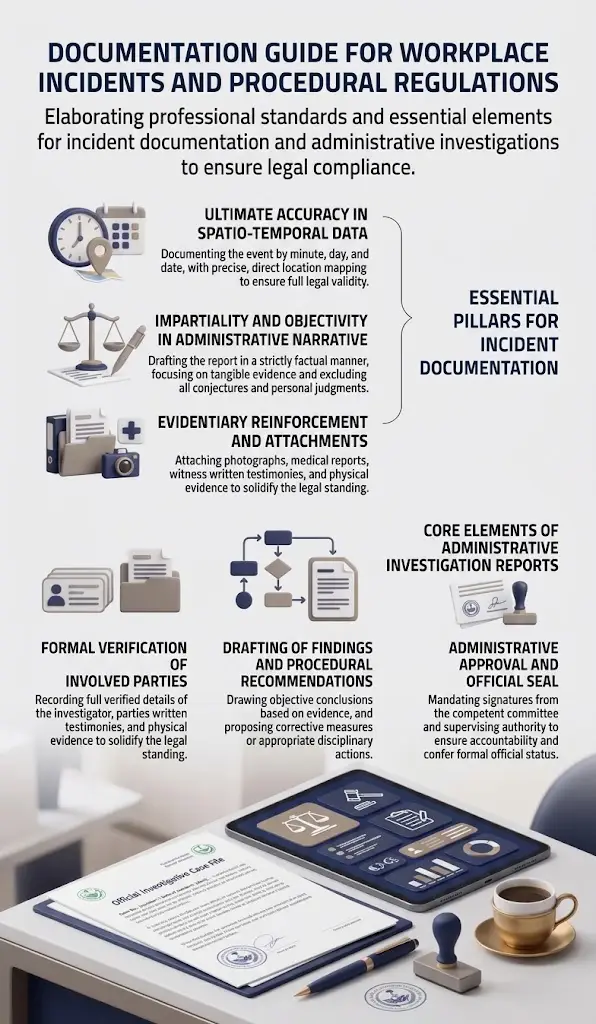
Infographic Summary: Documentation Guide for Workplace Incidents
Main Title: DOCUMENTATION GUIDE FOR WORKPLACE INCIDENTS AND PROCEDURAL REGULATIONS
Subtitle: Elaborating professional standards and essential elements for incident documentation and administrative investigations to ensure legal compliance.
1. Essential Pillars for Incident Documentation
- Ultimate Accuracy in Spatio-Temporal Data: Documenting the event by minute, day, and date, with precise, direct location mapping to ensure full legal validity.
- Impartiality and Objectivity in Administrative Narrative: Drafting the report in a strictly factual manner, focusing on tangible evidence and excluding all conjectures and personal judgments.
- Evidentiary Reinforcement and Attachments: Attaching photographs, medical reports, witness written testimonies, and physical evidence to solidify the legal standing.
2. Core Elements of Administrative Investigation Reports
- Formal Verification of Involved Parties: Recording full verified details of the investigator, parties written testimonies, and physical evidence to solidify the legal standing.
- Drafting of Findings and Procedural Recommendations: Drawing objective conclusions based on evidence, and proposing corrective measures or appropriate disciplinary actions.
- Administrative Approval and Official Seal: Mandating signatures from the competent committee and supervising authority to ensure accountability and confer formal official status.
Detailed Party Identification, Date, and Location Parameters
To maintain administrative and legal validity, the following details must be recorded:
Reporting Party and Involved Individuals: Full name (triple or quadruple), job title, National ID or Iqama number, employee ID, and direct contact number.
Disputing Parties or Alleged Violators: For internal investigations, details of the complainant, the respondent, and their exact job titles.
Temporal Parameters: Date recorded in both Hijri and Gregorian calendars, along with the exact time to prevent chronological overlap (accounting for specific scenarios such as wage delay records under Saudi Labor Law).
Spatial Parameters: Precise physical location, including department, section, or branch within the Kingdom.
Signatures and Seals: Formally signed by the report drafter, involved parties, and witnesses, finalized with the department manager’s authorization and official corporate seal.
Investigation Committee Details (if applicable): Names, ID numbers, and professional titles of designated committee members to establish inspection legitimacy.The objective narrative constitutes the core of the Incident Registration Request Form. Drafting requires a neutral writing style relying exclusively on observed physical facts, avoiding personal opinions, unsubstantiated claims, or premature accusations that lack material evidence before administrative or labor tribunals.
While administrative handling of workplace incidents requires precise record-keeping, escalating labor disputes to judicial authorities often necessitates specialized legal intervention. To ensure full compliance with Saudi Labor Law and protect corporate interests during formal proceedings, establishments frequently retain certified lawyers in Jeddah to draft formal legal defense memos and provide statutory representation before Labor Courts.
Rules for Writing Facts in a Sound Administrative Style
Objectivity and Impartiality: Record events strictly based on direct observations and statements.
Clarity and Conciseness: Present a structured account that clarifies the sequence of events without omitting material details.
Accurate Violation Classification: Clearly specify the nature of the event (e.g., professional misconduct, negligence, or administrative violation).
Logical Chronology: Organize the narrative logically—starting with a summary of the report, followed by statement summaries and evidence-based findings.
Separation of Facts and Opinions: Explicitly distinguish material facts from personal interpretations.
Verbatim Witness Statements: Record witness testimonies using their exact phrasing without altering intended meanings.
Incident Registration Request Form Template
(Official Administrative Document for Workplace Incident Reporting in KSA)
Kingdom of Saudi Arabia
Official Administrative Incident Registration Form
/
/ 144 AH
/
/ 202 AD
First: Reporting Party Details
Second: Temporal and Spatial Details of the Incident
/
/ 144 AH
(Corresponding to:
/
/ 202 AD)
AM / PM
Third: Objective Factual Narrative
(Detail the incident objectively and neutrally, describing the chronological sequence of events exactly as they occurred…)
Fourth: Supporting Evidence and Attachments
Signatures and Official Endorsement
Reporting Party:
HR / Administrative Endorsement:
Importance of Attaching Supporting Evidence and Documentation
The procedural weight of an Incident Registration Request Form relies on attached supporting evidence rather than verbal descriptions alone. Attaching verifiable material substantiates the report’s credibility, providing investigation committees and HR departments with conclusive evidence to reach fair decisions in accordance with Saudi statutory laws.
Primary Types of Attachments Strengthening Form Validity
Digital and Visual Evidence: High-resolution photographs and authenticated CCTV footage establishing the event.
Official Medical Reports: Issued by authorized health institutions within the Kingdom in cases of occupational injuries or accidents.
Identification Records: Valid National ID or Iqama copies for all involved parties.
Written Witness Statements: Signed written testimonies from colleagues or bystanders who witnessed the event.
Specialized Technical Reports: Occupational health and safety reports or technical facility inspection logs.
Documented Work Correspondence: Official emails or corporate communications verifying prior notices or disputes.
Frequently Asked Questions
What is the main purpose of an Incident Registration Request Form in Saudi workplaces?
The primary purpose is to materially record accidents, violations, or labor disputes in real time from an objective standpoint. It provides Human Resources departments with verified data to protect rights, disclaim legal liability, and support sound administrative actions under the Saudi Labor Law.
Does submitting an Incident Registration Form replace formal internal investigation minutes?
No, it does not replace formal investigation minutes. The form acts as an initial administrative record that triggers an official review. Enforcing disciplinary sanctions requires a subsequent formal investigation where all parties' statements are officially documented.
Is an employee's signature on the Incident Form considered an admission of guilt?
No. Signing the form generally acknowledges notice or witnessing of the factual recording. If an employee or party disputes the narrative, they have the legal right to record their explicit reservations alongside their signature.
What key details must be included in the form for it to be legally valid?
To maintain administrative and legal validity, the form must include the official entity header, complete identification of all parties (National ID/Iqama numbers), exact temporal (Hijri and Gregorian dates/time) and spatial parameters, an objective factual narrative, attached evidence, and official signatures with the corporate stamp.
What types of evidence should be attached to strengthen the Incident Registration Request?
The form should be supported by material evidence such as authenticated CCTV camera footage, locally certified medical reports, written and signed witness statements, specialized technical/safety inspection logs, and official work correspondence (e.g., emails).
How does objective incident recording help in labor disputes before Saudi Judicial Authorities?
An objectively drafted incident form serves as a reliable evidentiary reference before internal committees and legal tribunals (such as Labor Courts or the Board of Grievances). It prevents data loss, establishes chronological facts, and ensures compliance with statutory time limits and rules of limitation.
Utilizing a standardized template to document workplace incidents and violations serves as an administrative and legal safeguard for establishments and employees across the Kingdom of Saudi Arabia. Drafting the request neutrally and attaching verified supporting evidence under applicable statutory frameworks ensures formal acceptance and endorsement, promoting organizational stability and workplace justice.