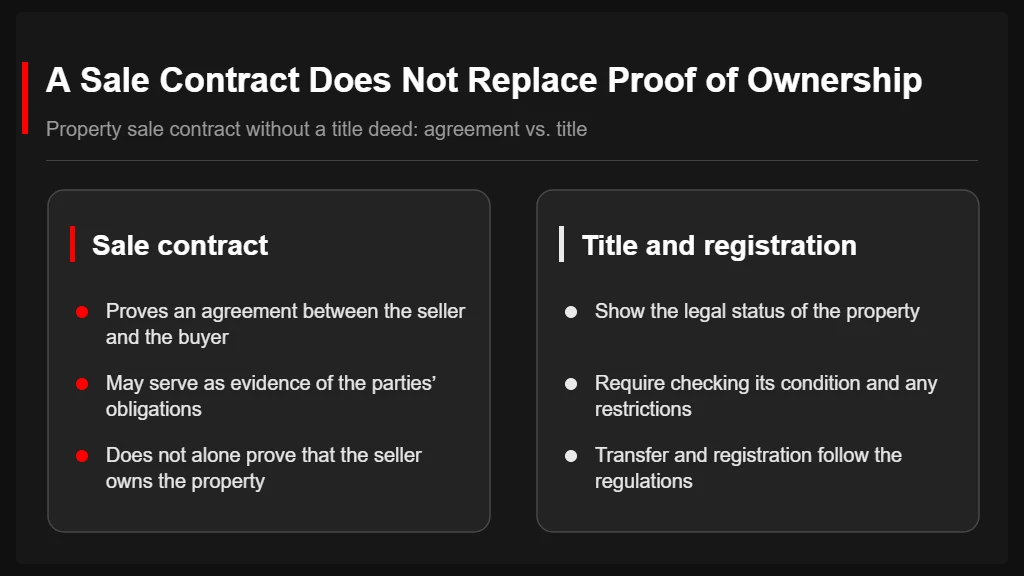
A property sale contract without a title deed may be used to evidence an agreement between the seller and the buyer and their obligations, but on its own it does not prove that the seller owns the property, and it does not replace the conveyance or registration that Saudi regulations require. Its effects depend on the nature of the land, the validity of the seller’s ownership, the documents available, and whether ownership can lawfully be transferred.
Not every property whose owner holds no paper deed is of unknown ownership: the deed may be electronic. Conversely, the land may be undocumented altogether, may belong to someone else, or may be subject to restrictions that bar its disposal.
That is why signing a property sale contract without a title deed, even in front of two witnesses and with the full price paid, is not enough on its own to ensure that ownership passes to the buyer.
This guide explains the legal ruling on such sales, the evidential weight of an informal paper, the rules on sale of another person’s property, a conditional preliminary-agreement template, 9 potential risks, and 7 practical checks before you pay the price.
محتويات الصفحة
What Is a Property Sale Contract Without a Title Deed?
A property sale contract is a document in which two parties agree to sell a specified property for a known price. It may describe the land, its boundaries and area, how the price is to be paid, the handover date, and each party’s obligations regarding the transfer of ownership.
The phrase “without a title deed” can describe several different legal situations, which must not be treated under a single rule.
| Property status | Meaning | Appropriate action |
|---|---|---|
| Electronic deed exists, but there is no paper copy | The property may be officially documented | Verify the deed, any restrictions, and whether conveyance is possible |
| Land with old sale papers only | Informal documents exist, but no approved title | Review the root of title and the chain of transfers |
| Property with a deed that is mortgaged or in dispute | A title exists, but disposal may be restricted | Check rights, restrictions and approvals |
| Land with no recognised title | The seller’s right to dispose of it is not established | Do not complete the purchase until the legal status is clear |
| Property owned in common | The seller may own only a share | Establish the share, the seller’s capacity, and the co-owners’ rights |
It follows that the absence of a deed may be a problem with the document, with the root of ownership, or with the ability to dispose of the property.
For readers who want the rules on undocumented land, our guide to the rules on land without title deeds in Saudi Arabia explains the routes to ownership and the treatment of informal documents, while this article focuses on the effect of the sale contract itself and the parties’ rights.
Does a Property Sale Contract Without a Title Deed Prove Ownership in Saudi Arabia?
On its own, a sale contract does not prove that the seller owns the property, although it may serve as evidence of an agreement and of obligations between the two parties.
The distinction is essential between the conclusion of a sale, proof of obligations, and the transfer of real ownership.
Under the Saudi Civil Transactions Law, Article 318 provides for ownership of the thing sold to pass upon conclusion of the sale, subject to Articles 655, 656 and 657. Article 319 requires the seller to take what is needed on their side to transfer ownership and to refrain from anything that makes the transfer impossible or difficult.
Article 655 provides that ownership and real rights pass by contract where the subject of the disposition belongs to the person making it, in accordance with the legal provisions.
Article 657 adds that where the law requires a particular procedure for the transfer of ownership or of a real right, the transfer does not take place until that procedure is completed. Accordingly, the conclusion of a sale alone is not enough where the property is subject to a mandatory legal procedure for transferring its ownership.
As for Article 13 of the Law of Real Estate Registration, it governs dispositions that follow first in-kind registration: they must be recorded in the real estate register, and the rights they cover take effect, with their judicial and administrative effects, only upon registration. This provision applies to properties registered in kind for the first time and must not be generalised to every property not yet registered in kind, since the procedures for unregistered properties vary with their status.
Accordingly, one must not confuse proof of a person’s undertaking to sell land with proof of ownership of the property and its legal transfer.
The Difference Between Proving the Sale and Proving Ownership
| Issue | What a sale paper may prove | What it does not prove on its own |
|---|---|---|
| Agreement to sell | Both parties’ consent to the price and terms | The seller’s ownership |
| Payment of the price | That payment was made, if supported by valid evidence | The buyer’s right to register a property that cannot be registered |
| Handover of the land | The fact of handover or possession, depending on the evidence | The validity of the root of ownership |
| Undertaking to convey | The seller’s promise to complete certain procedures | That conveyance is legally possible in every case |
| Transfer of ownership | May support claims for rights arising from the contract | Bypassing the mandatory legal registration |
What Is the Ruling on Selling Land Without a Title Deed Under Saudi Law?
It is not right to say that every sale of land without a deed is valid, nor that every such sale is automatically void.
The ruling depends on why the deed is absent, on the seller’s ownership, on the nature of the property, and on the legal conditions for disposal and registration.
Case One: The Deed Exists Electronically
If the property is documented by a valid electronic deed but the seller holds no paper copy, this does not mean that title is lacking.
What is needed is to verify the deed’s data, its holder and the restrictions recorded on it, and then to confirm that conveyance can be completed.
The Ministry of Justice offers ordinary conveyance as an electronic service (see its real estate conveyance e-service). In that route the electronic deed is a basic document, alongside proof of the parties’ identity, the registered means of payment and any approvals required for the type of property.
Case Two: The Land Is Not Documented at All
If there is no recognised title proving the seller’s ownership, an informal paper does not cure that gap.
One must determine whether there is an earlier ownership application, official documents, established third-party rights, or restrictions that prevent the acquisition of private ownership.
In this case, the buyer should not pay the price in reliance on the seller’s promise to obtain the deed later.
Case Three: The Land Belongs to Someone Else
If it is established that the seller does not own the land and has no authority to dispose of it, the rules on the sale of another person’s property apply.
This situation is fundamentally different from merely not carrying a printed copy of the deed.
Sale of Another Person’s Property Under the Civil Transactions Law: Articles 359 and 360
Article 359 of the Civil Transactions Law deals with the case where a person sells a specific thing that they do not own, without permission.
The article provides that the sale does not take effect against the owner unless the owner ratifies it, without prejudice to the rights of third parties. It also gives the buyer the right to request annulment of the sale, subject to its conditions, unless ownership of the thing sold passes to the seller after the contract or the owner ratifies the sale.
Article 360 allows a buyer who did not know that the thing sold was not owned by the seller to claim compensation if the sale is annulled, even if the seller acted in good faith.
This means that the phrase “selling land without a title deed is always void” is not an accurate legal formulation, because the outcome varies with the seller’s ownership, the owner’s ratification, the buyer’s rights, and the specific registration rules.
The provisions governing these matters are found in the officially published Civil Transactions Law. They are useful when assessing any property sale contract without a title deed in which it emerges that the seller does not own the property.
What Should the Buyer Do on Discovering That the Seller Does Not Own the Land?
Preserve all evidence first: the original contract, proof of payment, correspondence and the documents the seller gave to prove ownership. The right legal route then depends on the facts, since the claim may concern annulment of the sale, recovery of the money, compensation or another right. Do not file a claim in general terms before establishing why ownership did not pass, because a dispute with a seller who does not own the land is not the same as a dispute with an owner who refuses to perform a valid conveyance obligation.
Is a Property Sale Contract Without a Title Deed and Two Witnesses’ Testimony Enough?
A signed paper, testimony and proof of transfer of the price may help prove an agreement or a payment, if the evidence meets its legal conditions. In a property sale contract without a title deed, the value of this evidence lies in proving the agreement and the payment, not in creating ownership that the seller has not established.
But the testimony of two witnesses does not turn undocumented land into property of established ownership, and does not replace the deed or the required registration.
The Saudi Law of Evidence regulates the means of proof and their conditions, while ownership of real estate and its registration are governed by other rules that must be observed.
When assessing an old sale paper, four things must be distinguished:
- Whether the signature is validly attributed to its owner.
- Whether the agreement and its stated terms are established.
- Whether payment of the price or handover of possession is proved.
- Whether the root of the seller’s ownership is established and capable of transfer.
One of these may be proved without the others.
Notarising signatures or having witnesses present therefore does not replace examining the title. Witnesses may support the fact that an agreement took place, but they do not turn a property sale contract without a title deed into a document of title.
Wording a Property Sale Contract Without a Title Deed: A Safe Model Template
Many people look for a ready-to-sign template for a property sale contract without a title deed, with the names of the seller and buyer, the area, boundaries, price and witnesses.
But using a final sale form that includes an acknowledgement that the seller has transferred ownership of land whose ownership they cannot prove may create a new dispute instead of protecting the parties.
Where documents are missing, it is more appropriate to consider a conditional preliminary memorandum of understanding subject to verification, without treating it as an instrument that transfers ownership.
Template: Preliminary Memorandum of Understanding on Purchasing a Property After Verifying Ownership
Notice: the following wording is an educational model not intended for direct signing, and it is not a title deed or a final sale contract. A signed document may produce legal effects depending on its wording and the surrounding facts, so it should be reviewed with a specialist before use.
Title of the document: Preliminary memorandum of understanding on considering the purchase of a property after verifying its ownership.
Date: …… / …… / ……
Place of drafting: …………………
First party: …………………, ID number …………………, capacity …………………, address …………………
Second party: …………………, ID number …………………, address …………………
First — Description of the property under study
The property is located in the city of …………………, district …………………, plan number …………………, plot number …………………, with an estimated area of ………………… square metres.
The boundaries or coordinates and the available survey documents are set out in a separate annex, and this description is not an acknowledgement that the First Party’s ownership has been established.
Second — Status of the ownership documents
The First Party declares that the documents currently available to them are …………………, and that the status of the deed or registration is …………………
The First Party undertakes to provide the available documents so that the root of their right to dispose of the property can be verified, and this undertaking is not in itself evidence of ownership.
Third — Purpose of the memorandum
The memorandum aims to record the parties’ wish to consider a possible property transaction after the documents and legal restrictions have been verified.
This memorandum does not state that any transfer of ownership, conveyance or registration has taken place.
Fourth — Conditions of verification before a final sale
No final sale contract is concluded, no part of the price is paid and possession is not handed over, until the title, the capacity of the person disposing, the possibility of conveyance and registration, and the required approvals have been verified, unless a specialist approves another arrangement that is permissible and suitable for the circumstances.
Fifth — Verification period
The parties allot a period of ………………… for providing the documents and verifying their status with the competent authorities.
Sixth — Payments
This memorandum is not an acknowledgement of payment of a deposit or any part of the price.
If the circumstances call for arranging a future sum, how it will be held and the conditions for its return must be set out in a separate agreement reviewed by a specialist, after the legitimacy of the transaction has been verified.
Seventh — Inability to complete the procedures
If the right to dispose cannot be established, or the required registration cannot be completed within the stated period, no completed sale is to be presumed merely from this memorandum, and the obligations and rights that may have arisen are reviewed in accordance with the law and the parties’ actual agreements.
Eighth — Legal review
The document is to be submitted to a specialist before it is signed, to verify that its wording does not create unintended obligations or conflict with the regulations that apply to the property.
Parties’ details and signatures: to be completed after legal review and approval of the wording suited to the case.
When Should This Template Not Be Used?
It should not be used to cover the sale of another person’s property without permission, the disposal of land that may be state property, the proving of non-existent ownership, or payment of the price in return for an undocumented promise to obtain a deed.
For a property whose ownership is established and which can lawfully be sold, see our real estate legal services page, which covers sale and lease matters; it is not a substitute for checking the status of the property.
9 Risks When Signing a Property Sale Contract Without a Title Deed
A property sale contract without a title deed exposes the buyer to nine main risks, each of which can be checked before any money changes hands.
1. The Seller’s Ownership Is Not Established
Successive sale papers, informal documents or copies of records may not show that the seller has the right to dispose of the land. The buyer may find out only after paying that the seller never held that right.
2. Conveyance or Registration Cannot Be Completed
A detailed contract does not replace the documents the competent authority requires. If there is no recognised title, or a restriction is in place, the disposition may not be registrable.
3. The Area and Boundaries Differ From the Paper
Approximate areas, or boundaries described by neighbours and old landmarks without an approved survey document, can lead to a dispute over which land was sold and what was paid for.
4. Heirs or Co-Owners Hold Rights
One heir or co-owner may sell the whole property while owning only a share. Verify the seller’s capacity and each party’s share before signing.
5. A Mortgage, Attachment or Restriction Blocks Disposal
Even where a title exists, the property may be mortgaged, attached or restricted. A clause stating that the land is “free of encumbrances” does not prove that it is.
6. The Property Is Sold to More Than One Buyer
Where ownership is not clearly documented, earlier sales or competing claims may surface. Keeping documents helps prove the facts, but it does not resolve conflicting rights or replace the registration procedure.
7. The Land Cannot Be Privately Owned
The land may be state property, protected land or in an area where regulations bar private ownership. Possession, a fence or old buildings are not enough to prove that ownership is lawful.
8. Losing the Deposit or the Price
Paying cash, or transferring money to an intermediary, before the seller’s capacity is established makes it harder to prove why the payment was made and on what terms it can be refunded.
9. Relying on Unrecorded Promises
Statements such as “the deed will be issued soon” do not guarantee that an ownership application will be accepted. Base the decision on a status documented with the competent authority, not on the seller’s expectations.
7 Steps to Verify Before Buying Land Without a Title Deed
Before signing any property sale contract without a title deed, work through these seven checks.
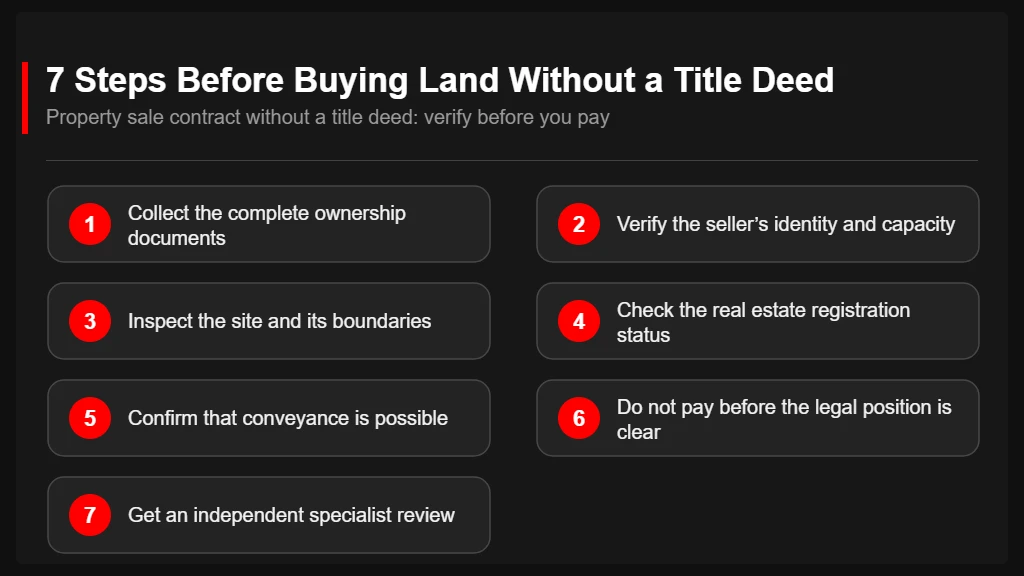
Step 1: Collect the Complete Ownership Documents
Ask the seller for every document relied on: the electronic deed if there is one, earlier document numbers, old sale papers and any official transactions concerning the property. If there is no recognised title, treat that as a fundamental obstacle, not a formality.
Step 2: Verify the Seller’s Identity and Capacity
Match the seller’s identity to the documents and check that any power of attorney is valid. For heirs or co-owners, confirm what the person signing is actually authorised to sell.
Step 3: Inspect the Site and Its Boundaries
Compare the actual site with the boundaries, area, plan number and plot number in the documents. If the difference is material, obtain a survey or planning check before committing.
Step 4: Check the Real Estate Registration Status
Establish whether the area is under in-kind registration, whether the property was registered before, and which rights and restrictions attach to it. REGA states that first in-kind registration requires a compliant electronic deed and a property in an announced area, among other requirements.
Step 5: Confirm That Conveyance Is Possible
Do not accept the seller’s assurance that conveyance is “guaranteed”. Confirm the competent authority’s requirements and check for restrictions, approvals or missing documents that would block the procedure.
Step 6: Do Not Pay Before the Legal Position Is Clear
If ownership or registrability is unresolved, do not pay the full price, or any new amount, on verbal promises. Any deposit or conditional sum should be drafted after specialist review, with the payment method, refund terms and the effects of non-completion.
Step 7: Have the Property Sale Contract Without a Title Deed Reviewed by an Independent Specialist
The wording may create a final obligation to sell, deliver or pay when the condition of the property does not allow it. Review the document and the papers together; the safest decision may be not to contract until the seller proves their right.
Practical Guide: Which Documents Are Required and What Can Block Conveyance?
Before buying a property, organising the documents helps determine whether the problem can be fixed or whether it prevents the deal from being completed at all.
| Item to check | Document or evidence | Likely effect if missing |
|---|---|---|
| Root of ownership | Electronic deed or recognised title, and the earlier chain of documents | Unable to confirm the seller’s right |
| Seller’s capacity | ID, power of attorney, or heirs’ and co-owners’ documents | Possible disposal without authority |
| Property data | Location, boundaries, area and plan | Difficulty identifying or registering the subject of the sale |
| Restrictions | Mortgages, rights, disputes and approvals | Transfer of ownership is held up |
| Payment | Bank transfers, receipts and clear agreements | Difficulty recovering sums in a dispute |
For ordinary real estate conveyance, the Ministry of Justice requires the parties or their lawful representatives to be present, the electronic deed, the registered means of payment, and additional requirements in some cases.
As for the first in-kind registration service, it has its own conditions relating to the property, the announced area and the documents.
What Can Cause First In-Kind Registration to Be Refused or Suspended?
The Implementing Regulations of the Law of Real Estate Registration distinguish between refusing a first in-kind registration application and suspending its procedures, and both differ from the track for applications to register dispositions that follow first in-kind registration. The regulations were amended by Board of Directors Resolution of the Real Estate General Authority No. (3/39/M/26) dated 17/04/1448 AH, published in the Umm Al-Qura Gazette on 30 October 2026, and take effect from the date of publication in the Official Gazette.
First: refusal of a first in-kind registration application. Under Article 14 bis, an application is refused only by a reasoned decision of the Real Estate Registrar, and on two grounds only:
- The ownership deed is not in force or is not valid; the applicant may re-submit the application after correcting the deed.
- The property subject to the application was already registered in kind when the application was submitted.
Second: suspension of first in-kind registration procedures. Suspension is not refusal. Among the cases under the amended regulations:
- A restriction on the property or its deed that prevents disposal, in which case procedures are suspended until it is removed (Article 10).
- Duplicate ownership deeds whose holders do not agree, in which case the Registrar suspends the procedures by a reasoned decision until the duplication is resolved legally, even if by a final court judgment. Suspension is not refusal, and it does not cause loss of priority of the application unless the Registrar so decides by a reasoned decision (Article 12).
- The difference between the deed’s lengths or area and the actual position exceeds the permitted margins in Table No. (1), in which case procedures are not completed until the difference is addressed (Article 13).
Third: incomplete applications. The amending resolution does not set a procedure or deadline for completing an incomplete first in-kind registration application, so no fixed period can be generalised to it. As for applications to register subsequent dispositions, an incomplete application is returned to be completed within 30 days from the date of submission and may be completed more than once; if it is not completed, the application is treated as if it had never been submitted (Article 26).
Fourth: dispositions following first in-kind registration. This is a different track from first in-kind registration: the Registrar issues a reasoned decision refusing the application, suspending it, or declaring loss of its priority, having regard to Article 21 of the Law of Real Estate Registration, and the applicant is notified of the decision and its reasons (Article 27).
An appeal against refusal, suspension or loss of priority suspends consideration of later applications until it is decided (Article 27 bis), and no account is taken in the order of priority of a refused application or one whose priority has been lost. The two grounds of refusal mentioned above are specific to the first in-kind registration application and must not be transferred to applications for subsequent dispositions.
How Long Do Ownership Transfer Procedures Take?
There is no single period for obtaining a deed on the strength of an informal sale paper with no title.
For ordinary conveyance that meets the requirements, the Ministry of Justice announces a period of up to 60 minutes to complete registration of ownership in the specified service, once the documents and conditions are complete.
This period does not include resolving disputes over the root of ownership, and does not mean that land for which the seller has no accepted title can be registered.
The Real Estate General Authority also explains that the period for first in-kind registration varies with the status of the application. No fixed date for completing the procedures can therefore be assumed merely because a property sale contract without a title deed has been signed.
Can a Deed Be Obtained on the Basis of an Old Land Sale Paper?
The existence of an old sale paper does not result in a deed being issued automatically.
One must verify the nature of the document and when it was issued, the root of ownership of the land, its eligibility for private ownership, and the administrative or judicial route available under the law.
The rules and working mechanism of the committees reviewing property ownership applications, published in the Umm Al-Qura Gazette, contained special conditions for accepting applications, including submitting ownership applications before 5/5/1444 AH, within the scope of those rules.
It is therefore wrong to promise the holder of an old sale paper that they can submit a new application for a deed at any time merely because they hold an informal contract or witnesses.
Three routes must be distinguished:
| Route | When it is considered |
|---|---|
| Application to own undocumented land | Where the case falls within the specialised rules on ownership applications and their conditions |
| First in-kind registration of a property | A property that meets the registration requirements in an announced area |
| Transfer of ownership of a registered property | Where a property is registered in kind and a disposition meets the conditions for transferring the right |
None of these procedures automatically replaces another. That is why signing a property sale contract without a title deed and then waiting for ownership to pass automatically is not enough.
Can a Lawsuit Be Filed to Prove Ownership of Land on the Strength of a Sale Paper?
A sale paper may be part of the evidence in a particular dispute, but there is no single lawsuit suited to all cases of undocumented land.
A dispute may concern proving that an agreement exists, claiming a refund of the price, compensation for an invalid disposition, or enforcing an obligation that can be enforced.
A claim to prove ownership of land with no title is subject to different rules, jurisdictions and conditions, and acceptance of the claim must not be assumed merely because witness testimony or informal contracts exist.
It is therefore necessary to identify the nature of the right to be protected before preparing the statement of claim or choosing the competent body.
Real Estate Transaction Tax and Registration Fees
The general rate of real estate transaction tax in Saudi Arabia is 5% on taxable transactions, with exemptions and conditions set by the law.
The Real Estate Transaction Tax Law published by the Zakat, Tax and Customs Authority sets out the framework in force since 10 April 2025.
A transaction being subject to tax, or the tax being paid, does not mean the seller’s ownership has been established or that the property can be conveyed.
| Procedure | Legal information | Caution |
|---|---|---|
| Real estate transaction tax | General rate 5%, subject to legal exceptions | Paying it does not cure a defect in ownership |
| Ordinary real estate conveyance at the Ministry of Justice | Published service cost: none; announced period of up to 60 minutes once requirements are met | Does not include obtaining a deed for land with no title |
| First in-kind registration | Free under Article 34 of the Law of Real Estate Registration | Fees may apply to other services under the regulations |
Article 34 of the Law of Real Estate Registration confirms that first in-kind registration procedures are free, while fees for some other registration services are regulated.
Frequently Asked Questions About a Property Sale Contract Without a Title Deed
Does a Property Sale Contract Without a Title Deed Prove Ownership?
No. On its own it does not prove the seller’s ownership. It may help prove an agreement and obligations between the parties, but it does not replace registration or conveyance. Verify the root of title, the seller’s capacity, any restrictions and the legal procedures before treating the deal as complete.
Can Land Be Sold Without an Electronic Deed?
First establish why there is no deed. If the property is documented and the title can be verified, the step may be completing or updating documents. If there is no recognised title at all, do not complete the sale or pay until the legal position and the possibility of transferring ownership are clear.
Is a Property Sale Contract Without a Title Deed, Signed by Two Witnesses, Enough to Obtain a Deed?
No. A paper and testimony may prove specific facts under the rules of evidence, but they do not automatically entitle the holder to a deed. Ownership applications and registration have their own requirements concerning the property, the documents and the competent authority.
What If I Signed a Property Sale Contract Without a Title Deed and the Seller Refuses Conveyance?
Gather the contract, proof of payment, correspondence and ownership documents, then establish why conveyance is not possible. Depending on the facts, the route may be to enforce an obligation that can be performed, to terminate the contract and recover the payments, or to claim compensation.
Is There a Model Property Sale Contract Without a Title Deed That Protects the Buyer?
No general template guarantees the safety of buying property whose ownership is unproven. A preliminary memorandum conditional on verification may suit some cases, but it does not replace a title or the legal procedures. Have it reviewed before signing or paying.
Is the Sale of Another Person’s Property Always Void in Saudi Arabia?
No. It is not automatically void, and the effects depend on the facts. Article 359 of the Civil Transactions Law governs the sale of a specified thing by someone who does not own it and has no permission: the sale does not bind the owner unless approved, and the buyer may seek annulment under its conditions. Article 360 governs compensation in the case it specifies. This is different from the mere absence of a paper copy of the deed.
Conclusion: How to Protect Your Rights Before Buying Property Without a Title Deed
A property sale contract without a title deed may be evidence of an agreement or obligation, but on its own it does not prove the seller’s ownership and does not replace the transfer and registration of ownership under Saudi regulations.
The safe decision starts with examining the title, the identity of the person disposing, the boundaries of the property, the rights and restrictions attached to it, and whether conveyance is possible; an old sale paper, witnesses or bank transfers are not enough to remove the problem of the root of ownership. If the property is undocumented, find out the legal route available before signing a property sale contract without a title deed or paying the price.
For more on the property procedures connected to this issue, you can consult our guide to the Saudi real estate registry and notarisation services to understand in-kind registration and the dispositions subject to it.
If you hold a sale paper or incomplete ownership documents, you can send a brief description of your case on WhatsApp to Saudi Laws Beacon to learn your options for follow-up or to ask for a specialist to be suggested where needed.
Notice: This article provides general legal information and is not individual legal advice. Cases involving the ownership of a property or the validity of a specific disposition require review of the documents and facts before any legal or financial step is taken.