Executive Summary
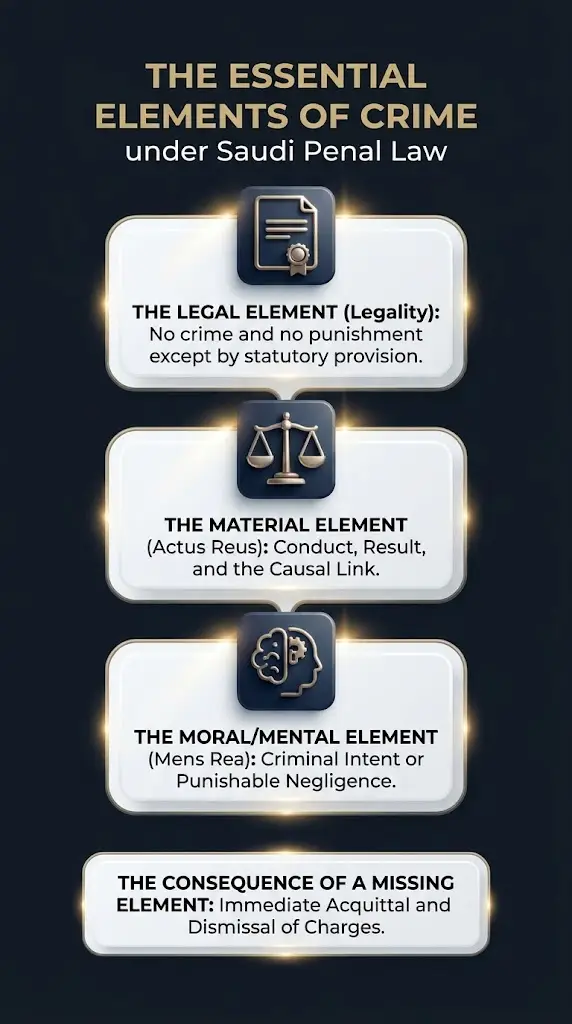
The Elements of crime under Saudi Law serve as the foundational legal framework required to establish criminal liability and enforce statutory penalties across judicial tribunals in the Kingdom of Saudi Arabia. According to Saudi penal jurisprudence, establishing any offense strictly necessitates the complete integration of three essential pillars: the Legal Element (Principle of Legality), the Material Element (Actus Reus), and the Moral Element (Mens Rea). The absence, defect, or breakdown of any single element fundamentally shatters the legal charge description, dictating an immediate acquittal, dismissal of charges, or the reclassification of the act under civil liability.
Understanding these procedural and substantive principles is paramount when drafting formal legal defenses, evaluating investigation files, or managing complex litigation before criminal courts and administrative bodies in Saudi Arabia.
محتويات الصفحة
Core Elements of Crime Under Saudi Law Explained
To fully understand how criminal responsibility is established, legal scholars and practitioners analyze the three core pillars that constitute the Elements of crime under Saudi Law. Under the Kingdom’s penal framework and Islamic jurisprudence, these components operate cumulatively rather than independently:
The Legal Element (Principle of Legality): Mandates that no conduct can be classified as an offense without a prior explicit statutory provision or codified Sharia text.
The Material Element (Actus Reus): Represents the tangible physical conduct, comprising the unlawful act or omission, the resulting material harm, and the direct causal link connecting them.
The Moral Element (Mens Rea): Establishes the psychological nexus and intent, proving either deliberate criminal volition or punishable negligence.
Introduction to the Tripartite Structure of Offenses
Understanding the foundational elements of crime in Saudi jurisprudence requires analyzing each component individually, alongside its objective and psychological prerequisites, as established by judicial precedents and academic literature. Securing a conviction or enforcing statutory penalties in the Kingdom of Saudi Arabia requires an absolute, structural integration of these fundamental pillars. If any element is invalidated, the law treats the alleged conduct as entirely permissible or reclassifies it strictly as a civil liability.
These procedural and substantive principles frequently govern complex litigation before the Execution Court in Riyadh or during formal criminal investigations across Saudi Arabia.
⚖️
Facing a Criminal Proceeding or Requiring Specialized Legal Analysis?
Navigating the Saudi judicial landscape and drafting valid legal defenses (Daf’) demands expert knowledge of local regulations and judicial precedents. Do not leave your legal rights to conjecture.
For precise legal representation before judicial authorities, clients may retain certified criminal defense lawyers in Jeddah to manage procedural and substantive litigation.
1. The Legal Element (Legality Principle) and Its Applications
The Legal Element in Saudi Penal Law is anchored in the foundational constitutional and judicial rule: “No crime and no punishment except by virtue of a legal text.” (Nullum crimen, nulla poena sine lege). This principle constitutes one of the prerequisite legal elements of crime under two primary legislative sources in the Kingdom:
Islamic Sharia Provisions: Which codify and govern specified offenses under Hudud (fixed scriptural penalties), Qisas (retaliation), and Ta’zir (discretionary scriptural offenses).
Statutory Penal Regulations (Royal Decrees): Which regulate and criminalize actions within statutory Ta’zir offenses (e.g., corporate crimes, cybercrime, forgery, bribery, and anti-theft regulations in Saudi law).
Under this principle, a criminal judge cannot classify an act or omission as an offense, nor impose any criminal sanction, unless the conduct was explicitly criminalized by statutory text or settled Sharia doctrine at the time of its commission. This protects the Principle of Legality and safeguards individuals against retrospective criminalization.
2. Components of the Material Element (Actus Reus)
The Material Element represents the tangible, external manifestation among the key elements of crime. Saudi law does not penalize mere thoughts or intentions unless they materialize into concrete physical conduct. It consists of three interrelated components:
Criminal Conduct (The Act or Omission): The physical movement or posture taken by the offender, taking one of two forms:
Positive Action: Direct physical execution of forgery, embezzlement, or fraud.
Negative Omission: Failure to fulfill a mandatory legal or Sharia duty. For example, corporate legal studies published in Qadha Journal highlight instances where an executive fails to disclose a company’s true financial position or conceals financial statements from partners or regulatory bodies.
Criminal Result: The direct physical or economic harm resulting from the unlawful conduct, such as asset loss in financial crimes.
Causal Link (Causation): The direct relationship connecting the criminal act to the resulting harm, establishing that the result was the direct consequence of the offender’s action and would not have occurred without it.
3. The Moral Element (Mens Rea) and Psychological Foundations
The Moral Element establishes the psychological nexus connecting the physical acts to the perpetrator’s persona. Crime is not merely an isolated physical event; it is a conscious human act driven by an intent that imputes culpability, making it essential when assessing the elements of crime.
Criminal Intent (Intentional Offenses): Comprises two essential cumulative components:
Knowledge: Sufficient awareness of all factual and legal elements of the crime, including knowledge that the conduct is legally prohibited and capable of causing the criminal result.
Will / Volition: The free, conscious exercise of will directed toward committing the act and achieving the prohibited outcome.
Criminal Fault / Negligence (Unintentional Offenses): In offenses where explicit criminal intent is not mandated by statute, Criminal Fault (recklessness, negligence, imprudence, or failure to observe regulations) satisfies the mental element.
Judicial precedents published by the Supreme Judicial Council confirm that the Saudi legal framework does not impose criminal liability upon physical actions unless committed by a discerning individual capable of bearing accountability.
Judicial Impact of Defective or Missing Elements
During trial, defense counsel and presiding judges analyze case files to verify the integrity of all statutory components. The failure or absence of any core elements of crime drastically alters the legal characterization of the suit:
| Defective or Missing Element | Legal & Judicial Characterization | Direct Legal Effect on the Accused |
|---|---|---|
| Absence of Legal Element | Complete lack of criminalization (Act is lawful or purely civil). | Immediate acquittal and dismissal of charges due to lack of statutory basis. |
| Severance of Causal Link | Failure to attribute the direct physical harm to the defendant. | Acquittal from major charges; liability restricted to minor acts (if applicable). |
| Absence of Criminal Intent | Reclassification from an intentional crime to a negligent act. | Radical reduction in penalty and modification of the legal charge description. |
Legal Defenses: Interruption of Causation & Bars to Liability
While the absence of core elements prevents a crime from coming into existence, certain external or personal factors may arise that break causation or bar criminal accountability even if physical acts occurred.
A. Causes of Interruption in Causation
Based on Saudi penal jurisprudence and standard commentaries on the General Penal System, causation is legally severed by:
Intervening External Force (Foreign Cause): An independent event or third-party act entirely outside the perpetrator’s control that directly causes the criminal result.
Force Majeure / Sudden Event: An entirely unforeseen, irresistible event that directly causes the harm despite the individual’s inability to prevent it.
Victim’s Contributory Negligence: Gross negligence by the victim that directly causes or contributes to their own harm, completely absorbing or severing the defendant’s mistake.
B. Bars to Criminal Liability (Exculpatory Factors)
Bars to liability are personal conditions affecting the offender’s capacity or freedom of choice at the time of the act:
Incapacity / Impaired Perception:
Insanity / Mental Illness: Total loss of reason or consciousness that eliminates perception and intent at the time of commission.
Minority (Lack of Discernment): Falling below the age of legal accountability under Sharia and statutory rules.
Impaired Free Will / Justifications:
Coercion / Duress: Acting under irresistible physical or moral compulsion.
State of Necessity: Committing a prohibited act to protect life or property from imminent, grave danger not caused by the actor.
Self-Defense (Difa’ Shar’i): Using proportionate, necessary force to repel an unlawful, imminent aggression against person or property.
Frequently Asked Questions
What happens if one of the core elements of crime is missing in a Saudi criminal suit?
Under the Saudi Penal System, if any of the three core elements of crime (the Legal, Material, or Moral element) is missing or proven defective, criminal liability cannot be established. The presiding judge is legally obligated to dismiss the charges or render an immediate acquittal (Al-Bara'ah) due to the lack of a statutory or legal basis.
How does Saudi Penal Law distinguish between an intentional crime and a negligent offense?
The distinction lies in the Moral Element (Men's Rea). Intentional crimes require both full knowledge of the illegality and conscious volition to achieve the unlawful outcome (Culpable Intent). In contrast, negligent offenses do not require intentional volition; criminal liability is established through Statutory Fault (Al-Khata' Al-Jina'i), such as recklessness, failure to observe regulations, or extreme negligence.
What constitutes a severance of the causal link (Rabitah Al-Sababiyyah) under Saudi jurisprudence?
A causal link between the defendant’s conduct and the criminal result is severed when an independent, external factor directly causes the outcome. Under Saudi law, causation is legally interrupted by a foreign cause (Sabab Ajnabi), force majeure (Al-Quwwah Al-Qahirah), or gross contributory negligence by the victim that completely absorbs the defendant's mistake.
What are the recognized bars to criminal liability (Exculpatory Factors) in Saudi Arabia?
Bars to criminal liability (Mawani' Al-Mas'ouliyyah) are conditions that impair a defendant's legal capacity or free volition at the time of the act. In Saudi jurisprudence, these include total insanity or mental incapacity, minority (lack of legal discernment), physical or moral coercion (Ikrah), state of necessity (Halat Al-Darurah), and legitimate self-defense (Difa' Shar'i).
Can a person be criminally prosecuted in Saudi Arabia for mere thoughts or unexecuted intentions?
No. Under the Principle of Legality and the requirements of the Material Element (Actus Reus), Saudi law does not penalize mere internal thoughts, motives, or intentions unless they manifest into concrete, unlawful physical conduct or an explicit statutory attempt (Al-Shuru').
How does the Principle of Legality protect individuals under the Saudi legal system?
The Principle of Legality (Nullum crimen, nulla poena sine lege) is an essential component among the elements of crime in Saudi Law. Codified under constitutional and statutory frameworks, it dictates that no act or omission can be classified as an offense, nor can a penalty be imposed, unless explicitly prohibited by Sharia provisions or statutory Royal Decrees enacted prior to the commission of the act.
Systematic and judicial analysis demonstrates that an offense under Saudi legislation is not merely a transient physical act; rather, it is a complex legal structure that strictly requires the total integration of its tripartite foundation: the Legal, Material, and Moral elements. A comprehensive understanding of the elements of crime provides legal practitioners, academic researchers, and interested parties with precise insights into the practical application of statutory provisions and defense strategies.
Ultimately, the breakdown of any core structural component—or the presence of a foreign cause interrupting causation or a legal bar to liability—fundamentally alters the legal standing, dictating an acquittal or the invalidation of the legal charge description. This underscores the paramount importance of meticulousness when documenting legal defenses and supporting evidence before judicial tribunals.
🛡️
Legal Disclaimer
The regulatory analysis, judicial precedents, and statutory information contained in this report are compiled solely for general legal education, academic study, and informational purposes based on publicly available Saudi legal sources. This material does not constitute tailored legal advice, nor does it substitute for consulting a licensed attorney or referencing the competent judicial authorities in the Kingdom of Saudi Arabia. Parties seeking advice on specific claims or individualized legal matters are strongly advised to consult certified legal practitioners.