
This guide covers the legal route for a worker to change employer in Saudi Arabia, as far as the official sources linked in the text describe it. The legal reference is the Saudi Labor Law and the Ministry of Human Resources and Social Development (HRSD) procedures for the transfer of services on the Qiwa platform.
Sponsorship transfer in Saudi Arabia (officially a “transfer of services”) is the legal way for a foreign worker to move to a new employer under the electronic procedures that now govern the Saudi labor market. If you are thinking of changing employer, or you want to know the exact official rules, understanding the administrative details is an important step to avoid having your request rejected.
The Saudi Labor Law, as explained by the Ministry of Human Resources and Social Development (HRSD), regulates the employment relationship, and many expatriates and employers search for the conditions of sponsorship transfer to make sure the procedure is carried out lawfully. This guide sets out the conditions, the steps on the Qiwa platform, the cases where a worker may move without the employer’s consent, the common reasons for rejection and the worker’s rights.
If your transfer request was rejected or delayed, or you have a dispute with your employer over the transfer, you can contact Manarat Al-Qawanin for help in finding the appropriate route or specialist. Your documents should still be reviewed by a qualified lawyer if you need a legal opinion on your own case.
Manarat Al-Qawanin is an independent legal information and guidance platform, not a law firm.
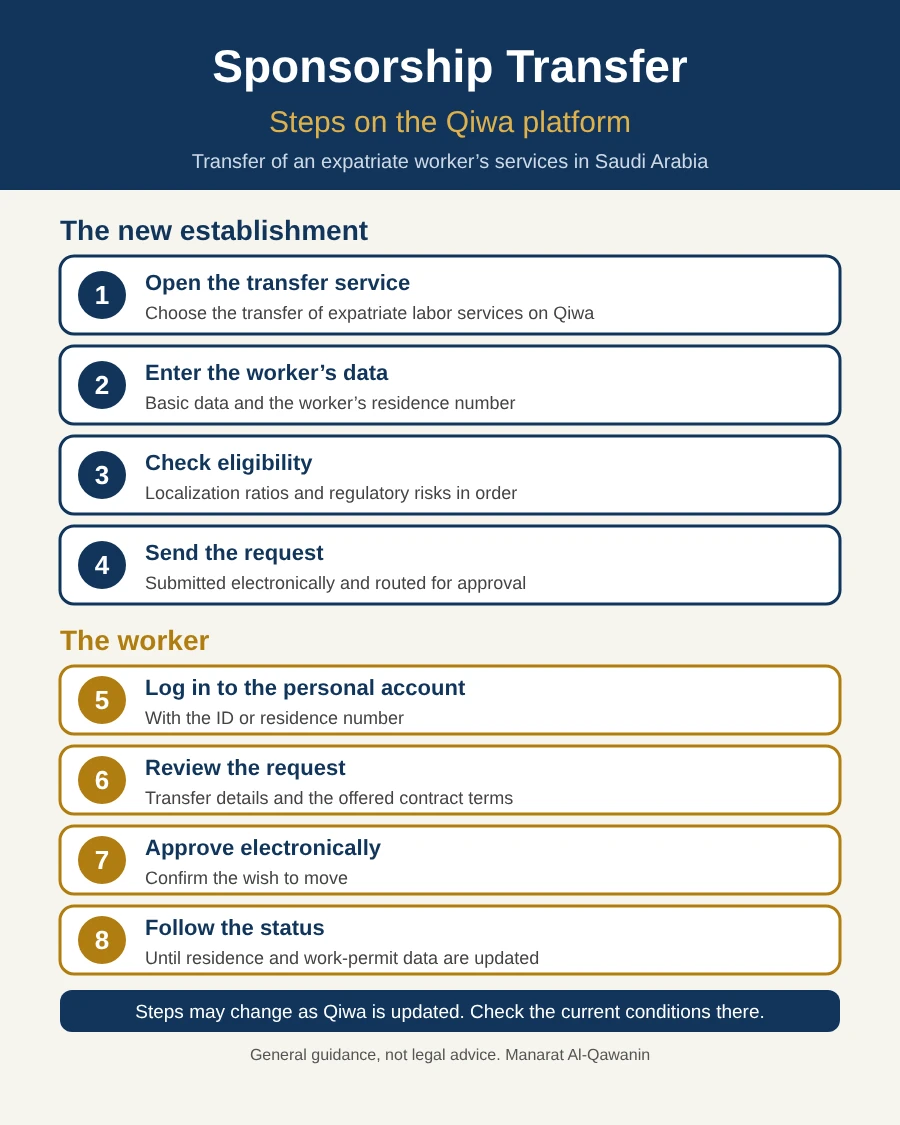
Table of Contents
Understanding the Conditions and Procedures for Sponsorship Transfer
Knowing the basic concepts and the official terms is the first step in understanding the changes in the Saudi labor market, where the new structure of the contractual relationship aims to strengthen the rights of the parties and the transparency of unified electronic procedures.
The Difference Between Transfer of Services and Changing the Workplace
A transfer of services is the legal process by which a worker moves completely from one establishment to another, taking his professional record and work number under the new establishment, subject to specific conditions.
- Do not confuse a transfer of services with other procedures such as resignation, termination of the employment contract, changing the profession, or issuing a new visa to enter the Kingdom.
- A change of workplace is limited to the administrative and contractual framework approved in the digital systems designed to manage jobs and the workforce.
- A transfer of services requires meeting specific conditions relating to the validity of the work permit and residence, or to the exceptional cases that allow a transfer.
- Once the transfer is complete, all labor obligations and responsibilities pass to the new employer under the new employment contract.
Conditions for Sponsorship Transfer Under the New System
A job transfer requires meeting precise statutory and regulatory criteria that determine the eligibility of both the worker and the receiving establishment, so that the request complies with the regulations and rules issued by the bodies responsible for the labor system.
Conditions for the Receiving Establishment
The receiving establishment is subject to a number of criteria and requirements that qualify it to recruit expatriate workers and complete a request to transfer a worker’s services.
- The new establishment meets the applicable eligibility and localization (Saudization) requirements according to its activity and legal form.
- There is no legal impediment or suspension preventing the establishment from carrying out the transfer-of-services procedure.
- The worker and the establishment meet the requirements for the transfer request according to the case.
- The required data and electronic procedures are completed through the approved platform.
Can You Transfer Sponsorship Without the Employer’s Consent?
The new regulations set out clear and regulated paths that allow an expatriate worker to move to another establishment in specific cases without the consent of the current employer, in order to protect workers’ rights and the stability of the labor market.
Cases of Transfer Without the Sponsor’s Consent
The most detailed official description of the transfer cases that I could check is the Qiwa user guide published on the HRSD website (Arabic). Its file is dated 2023 and it prints no edition date. HRSD’s own service page for “Transfer of services from another employer (Freedom of movement)” says only that a resident worker can move without the current employer’s approval, subject to HRSD’s regulations and conditions, and it does not list them. Check the conditions shown on Qiwa at the time of your request, because they can change.
According to that guide, a transfer request falls into one of three cases:
- Direct transfer, with no consent and no notice period. The worker’s work permit or residence permit has expired.
- Transfer without consent, with a notice period. More than one year has passed since the worker’s first entry into the Kingdom, and the new establishment documents 100% of its non-Saudi workers’ contracts on Qiwa and has an approved internal work regulation. The notice period is 90 days, counted from the moment the request reaches the “waiting for notice period” status on Qiwa, and the current employer can shorten it.
- Transfer that needs the current employer’s approval, with no notice period. Less than one year has passed since first entry, or the new establishment does not meet one of the two conditions above.
For any transfer the guide also requires an active establishment with valid licences, enrolment in the Wage Protection Program, and the worker’s own approval of the request and the contract through his personal Qiwa account. The guide lists the transfer of a domestic worker as a separate type of request, so check Qiwa for the rules that apply to it. A temporary work visa cannot be converted to a permanent professional visa or transferred.
These cases are not the same as the exemptions sometimes repeated online, such as three months of unpaid wages or a work permit not issued within 90 days of entry. I did not find those listed as transfer exemptions in the official guide, so do not rely on them without checking the current Qiwa conditions or taking advice.
Where a documented contract has ended without renewal, check your position on Qiwa before acting; I did not find an official source that sets out a separate rule for this case.
Sponsorship Transfer When the Contract Is Not Documented
Where there is no written contract, or the contract has not been documented electronically, many questions arise about whether a move is lawful and possible. The system sets specific controls to regulate these cases and protect the related rights.
How to Correct Your Status If You Discover the Contract Is Not Documented
A worker who discovers that his contract has not been registered or documented electronically should take the correct statutory steps to protect his rights and avoid disruption.
- Ask the current employer, without delay, to document the contract electronically through the digital platform designed for that purpose.
- Keep all evidence and documents that prove an actual employment relationship, such as bank statements or wage transfers.
- Approach the relevant authorities or file an official labor complaint if the employer refuses to document the contract or to acknowledge the relationship.
- Seek specialized legal advice to assess the effect of the missing contract documentation on the possibility of requesting a transfer of services under the regulations.
Steps to Transfer Sponsorship on the Qiwa Platform
Administrative procedures are now carried out entirely through the approved digital platforms, which makes it easier for the parties to complete and follow their requests transparently and accurately. Requests are submitted electronically through the official digital platforms in specific steps.
- The service for transferring a worker’s services is provided electronically through the Qiwa platform, according to the service available to the establishment and the worker’s status.
- Choose the service for transferring the services of expatriate labor and enter the basic data required for the worker to be transferred and his residence number.
- Review the establishment’s eligibility conditions and confirm that the localization ratios and regulatory risks are in order before sending the request.
- Send the request electronically so that you are notified of the next steps and the request is routed to the relevant bodies for approval or processing. Note that some steps of the electronic interface may differ according to updates to the Qiwa platform and the services available at the time of submission.
Steps the Worker Must Complete After the Request Is Submitted
The worker must follow the request submitted by the new establishment and complete the necessary approval through his personal account on the digital platform.
- Log in to the portal designed for individuals, or to the approved platform, using the ID or residence number.
- Review the details of the transfer-of-services request submitted by the new employer and the terms of the employment contract offered.
- Approve the request electronically to confirm the wish to move and complete the remaining statutory requirements.
- Follow the status of the request until the transfer is complete and the residence and work-permit data are updated under the new establishment.
How Long Does a Sponsorship Transfer Take?
The time needed to complete transfer requests is affected by several technical and administrative factors relating to the completion of the conditions and the response of the relevant authorities and parties. Processing time varies by the type of request, whether the conditions are complete, the approvals required, and the status of the worker and the establishment. A single period therefore cannot be stated for all requests, and the status of the request can be followed electronically through the approved platform.
The speed of completion depends on the response of the parties and on obtaining the necessary approvals through the digital platforms.
- The period may be longer in some cases that require an administrative review or verification of eligibility conditions and the new establishment’s localization ratios.
- A definite period cannot be stated for all cases because the administrative and technical circumstances of each request differ.
Why Is a Sponsorship Transfer Request Delayed?
A transfer-of-services request that stays pending or under processing indicates additional requirements or administrative reviews that have not yet been completed.
- The delay may be because the current employer has not yet responded to the request, in cases where his approval or a notice period applies.
- There are technical remarks relating to the localization ratios or the work permits of the new establishment or the worker.
- The competent authorities are verifying that the statutory conditions are met in exceptional cases that do not require the sponsor’s consent.
- The details of the request should be reviewed on the electronic platform to find the exact reason for the delay and to resolve it where possible.
Reasons a Sponsorship Transfer Is Rejected and How to Deal With Them
Some requests meet obstacles that delay or reject them. It is important to understand the reasons precisely and to apply the appropriate corrective steps. Reasons for rejection relate to the statutory conditions not being met, or to legal and administrative obstacles that prevent the move from being completed.
- There is a legal impediment, or a final decision or judgment, that conflicts with the transfer of the worker’s services, or the conditions required for the case are not met.
- The new establishment does not meet the requirements of its Nitaqat (localization) category, or it has material violations that prevent it from accepting new workers.
- The statutory conditions required for the worker’s case are not available, or the data entered in the electronic request is incorrect.
- The current employer has not approved the request in cases where statutory approval is required according to the type of contract in force.
How Can You Deal With Remarks on, or Rejection of, a Transfer Request?
Dealing with a rejection requires identifying the root cause of the problem and taking suitable corrective steps in line with the applicable regulations.
- Review the reasons for rejection shown in the electronic system and consult the competent authority or a legal specialist.
- Settle any existing labor disputes, or remove the administrative violations linked to the worker’s residence or work permit.
- Correct the status of the new establishment and reach the required localization ratios before submitting the request again.
- Submit a new request once the reasons for the earlier rejection have been removed, with all statutory conditions met.
Worker’s Rights When Moving to a New Employer
The labor regulations preserve the financial rights and legal gains of all parties during the transition and clearly identify who is responsible for fees and obligations. They set out the responsibilities and financial obligations arising from the transfer of services between the two establishments and the worker.
- Under Article 40 of the Saudi Labor Law, as published by HRSD, the employer bears the fee for transferring the services of a worker who wishes to move to him. The same article also places recruitment fees, residence and work-permit fees and their renewal on the employer.
- The only worker-borne costs that Article 40 names are the worker’s return costs if he is unfit for work or wants to return without a legitimate reason.
- Previous financial dues, such as overdue wages or end-of-service benefits, remain owed by the current employer unless they have been settled.
- Financial claims linked to the previous contract require recourse to the competent authorities if there is a dispute between the parties.
Can the Worker Move If the Employer Breaches His Rights?
A proven breach by the employer of essential obligations under the contract may give the worker grounds to take the statutory procedures, including a labor complaint.
- An employer’s breach of his statutory or contractual obligations may have legal consequences for the employment relationship, and in some cases the worker may have statutory paths to move without the employer’s consent, depending on the nature of the breach and the controls that apply.
- Forcing the worker to perform work that differs fundamentally from the agreed profession without his prior consent is dealt with within the statutory frameworks.
- Proven abuse by the establishment, or serious harm to the worker, is dealt with through the official channels and labor complaints.
- These cases require documented evidence and documents so that the request is accepted and dealt with through the correct statutory channels.
Mistakes to Avoid When Transferring Sponsorship
Some inaccurate practices delay the procedures or lead to regulatory violations that expose the parties to the prescribed penalties and fines. Administrative or technical mistakes can cause the request to be suspended or finally rejected by the competent digital platforms.
- Entering incorrect data, or data that does not match the residence number or the establishment’s data, when submitting the electronic request.
- Starting the transfer procedures without confirming that the statutory conditions and obligations for the case are met.
- Wrongly believing that having no contract gives an absolute right to move without checking the statutory conditions.
- Neglecting to follow the electronic request, and the worker not responding to the approval within the deadlines set by the system.
May a Worker Start Work Before the Transfer of Services Is Complete?
Starting work with a new employer before the statutory transfer procedures are complete may breach the regulations governing work and residence, so work should not begin before the transfer is officially complete.
- Starting work before the transfer is complete leads to serious statutory violations against both the worker and the new employer.
- This practice is a breach of residence and labor regulations and may expose the establishment and the worker to penalties and financial fines.
- Wait until the worker’s status appears in the system as “transferred” and the updated documents have been officially issued.
- The current employer may remain legally responsible until the transfer procedures are officially completed.
Settlement Procedures When There Is a Labor Dispute
Some complex cases, or cases marked by labor disputes, require precise specialist intervention to make sure the correct statutory steps are taken and harm is avoided. Where there is a dispute between the worker and the employer over the transfer procedures, handle it carefully within the approved statutory frameworks.
- Avoid hasty individual actions that may harm the worker’s legal status inside the Kingdom.
- Document all correspondence, documents and agreements linked to the contract and the financial dealings between the parties.
- Resort to amicable settlement as a first step to resolve the dispute before escalating it to the competent labor courts.
- Seek a legal specialist to study the available options and give sound advice based on the applicable regulations. You can see how to find a lawyer who handles labor cases through the platform’s guide.
Legal Documents Needed to Assess Your Employment Position Accurately
Having the right supporting documents enables specialists to assess the legal position accurately and estimate the chances of success.
- A copy of the current employment contract and its documentation records, or proof that it was not documented electronically.
- Bank statements showing whether wages and monthly salaries were paid.
- Notifications or requests submitted through the digital platforms relating to the transfer of services, and their outcomes.
- Any official correspondence or warnings exchanged between the worker and the current or new establishment.
Before you rely on this summary of sponsorship transfer in Saudi Arabia, confirm the details with the competent authority or a licensed lawyer.
Frequently Asked Questions About Sponsorship Transfer in Saudi Arabia
Is the current employer’s consent required in every transfer of services?
No, not in every case. The regulations allow a worker to move without the sponsor’s consent in specific cases, according to the controls that regulate this.
Is the worker’s consent required to complete a transfer of services?
Yes. A transfer of services requires the worker’s express consent and acknowledgement of the move through the approved digital platform.
Who bears the fees for transferring services and for the work permit?
The Labor Law provides that the employer bears the fee for transferring the services of a worker who wishes to move to him.
Can a worker move if the employment contract ends and he does not wish to renew it?
It depends on your case on Qiwa. According to the Qiwa user guide published by HRSD, a worker can move without the current employer’s approval when the work permit or residence permit has expired, or, after more than one year since first entry into the Kingdom, with a 90-day notice period if the new establishment meets the conditions. Check your case on Qiwa before acting.
Can a worker move if wages have not been received for a certain period?
An employer’s failure to meet wage obligations may affect the worker’s statutory position, and whether a transfer without consent is possible depends on the conditions and controls that apply to the case.
How long does it take to decide an electronic transfer-of-services request?
There is no single period that can be generalized. The time varies by the type of request, whether the conditions are complete and the approvals required, and the request can be followed electronically.
Conclusion
Transferring services, commonly called sponsorship transfer under the new system, requires careful compliance with the statutory controls and conditions set by the official bodies in Saudi Arabia, whether in cases that require the current employer’s consent or in the exceptional cases that allow a move without it. The request must be completed electronically, and the conditions relating to the worker and the new establishment must be met, to avoid rejection or delay.
If you face difficulties or a labor dispute over a transfer of services, use the official amicable settlement channels or the competent labor judicial bodies, and take care to document all documents and contracts so that your statutory rights are preserved under the Ministry of Human Resources and Social Development regulations.
Disclaimer: Manarat Al-Qawanin is an independent legal information and guidance platform, not a law firm, and it does not provide court representation or individual legal advice in its own name. This article explains the general rules and is no substitute for reviewing the details of your case with a qualified specialist. Procedures and the Qiwa interface may change, so check the official platform before acting.